|
You can injure your back playing racquet sorts or even just be picking up
something off the floor. Anytime you bend or stretch you may put your back at
risk. These injuries cause back aches that can require the attention of a
health care professional.
There are many causes of back aches, ranging from muscle strains, that heal
on their own after several days, to herniated discs that may require serious
health care attention. Athletes, and others who exercise, frequently subject
their backs to sports that put pressure on their spines.
The back is made up of 24 vertebral bones separated by flexible disks,
multiple layers of ligaments and muscles and two dozen joints. The spinal
cord is protected by the backbone which surrounds it. Nerves branch off from
the spinal cord and exit between the vertebrae. These nerves carry signals
back and forth between the brain and the rest of the body. Pain can originate
in any of these parts of the back.
Most back problems in adult athletes do not cause long-term disability, but
can cause severe pain for several days. At about age 20, the intervertebral
disks begin to wear and they may bulge out beyond the spine. Herniated disks
are the most common cause of nerve pain, like sciatica that follows the path
of the sciatic nerve down the leg.
Disk problems can cause numbness or muscle weakness in a leg, foot, arm or
fingers or even interfere with urination or defecation. As the disks
continue to deflate, the spaces between the vertebrae become narrower and the
bones can begin to wear causing pain, stiffness, numbness and muscle weakness.
Aching backs can also be caused by infection, tumor, trauma, muscle spasms,
strains or sprains.
Preventative exercise routines are the key to avoiding low back pain or
injury. It is common to stretch the legs before beginning strenuous
exercise, but it is also necessary to gently stretch the spinal column.
Muscles and tendons tend to lose elasticity as we age, so be sure to spend a
reasonable amount of time gradually warming up your back.
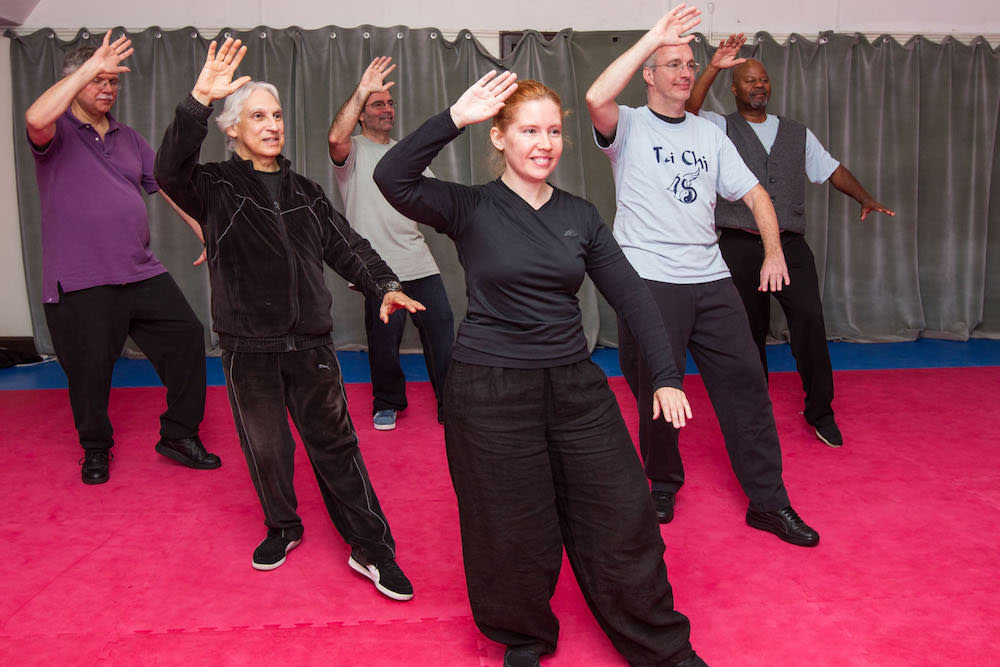
Many Chi Kung exercises are excellent for working your back without injury.
Check with your Tai Chi Instructor to see which exercises are good for you
specifically and which ones you may need to avoid at this time. It is
dangerous to assume that a particular exercise recommended for the general
population is suitable for you, if you have any special concerns regarding
your back.
Slow, gentle turning and bending type of exercises may be appropriate for
you, but should be performed carefully, playing close attention to proper
alignment and the how you feel while doing the exercise. Become aware of
what works for you and what doesn't. This may certainly change from time to
time. Be adaptable. Again, when in doubt speak to your instructor.
If you have injured your back, it is usually desirable to apply ice
frequently to reduce any swelling for the first 24 to 48 hours. After a day
or two apply moist heat, but only for 15 or 20 minutes at a time. Any longer
can tire the muscle and even lead to further injury. (Be careful not to burn
yourself)
Half of all back pain becomes better within a week. But a visit to your
health care professional is always the safest method of making sure you don't
have a serious injury. if your pain grows worse, definitely see your doctor.
Worsening signs include not being able to raise your toes, weakness or pain
radiating up or down an arm or leg or a change in your bowel or bladder
habits.
Give yourself time to recover completely before resuming normal activities.
Tai Chi, Chi Kung and swimming are good activities to help your recovery and
are less likely to put excess pressure on your back. Study only with a
properly qualified teacher who also has some training in anatomy to get the
most benefit, with the least danger, from your Tai Chi training.
|